A popular Germanic programme of Beethoven and Brahms ensured a capacity house at the DFP for Eiji Oue's concert with the MPO. Opening the concert with Beethoven's Leonore No. 3 Overture - the best of his 4 overtures written for his only opera Fidelio, maestro Oue gave a vibrant and zealous account, presenting a deliberate opening which added an extra degree of tension before leading into a robust airing of the main theme, with a particularly fine patina of rich string sound and dignified brass tone.
Unfortunately, the woodwinds' balance was recessed, especially the important heroic flute solo. After the ensuing quieter interlude, the off-stage trumpet solo was crisply played by William Theis. The music then soon re-erupted into a rumbustious and joyful blast, leading to a terrifically exciting conclusion.
The unquestionable highlight of the concert was the Brahms' Double Concerto Op 102, performed by the two superb DFP debutants, the South Korean violinist Soyoung Yoon and Hungarian cellist István Várdai. The sense of empathy between them was palpable throughout the entire performance. The solo violin and cello truly sang as one single instrument with an extended range and rich timbre. It was perfect rhythmic and dynamically coordinated duet playing.
Oue and the MPO announced the brief forte opening unison statement with indomitable vigour, whose expressive strength was taken up and even amplified by the solo cello’s and violin's opening pensive recitatives. Várdai’s eloquent cello playing registered more strongly than Yoon’s lively contribution, though both soloists exhibited faultless technical and musical command of the score. The minor tonal imbalance was probably due to Várdai’s superb 1673 “ex-Du Pre-Harrell” Stradivarius cello outshining Yoon's fine 1773 "ex-Bückeburg" JB Guadagnini violin, despite maestro Oue's judicious control of the orchestral textures and dynamic balance.
The flowingly paced D major Andante was radiantly played, with Yoon and Várdai spinning warm, silky and eloquent melodic lines of intimate heavenly beauty. Várdai began the brightly-paced final Vivace non troppo movement in an impish manner, bringing out its Hungarian gypsy flavour and folk-dance qualities duly answered by the equally mischievous-sounding Yoon. As the music turned to its tonic major, both soloists, the MPO and Oue brought Brahms' magnificent concerto to a grand conclusion.
After the interval, Oue's interpretation of Beethoven’s Symphony No 5 in C minor was a good symphonic account. Oue thrashed around wildly in all directions, often exceeding the exaggerated stage manner of his mentor Leonard Bernstein as he implored the MPO to give yet more and more. Often the MPO's response was slightly muted and detached relative to Oue's original intentions and it was frankly a bit tiring to watch maestro Oue leaping around on the podium.
Gesturing vigorously to keep a palpable decent pace, he drew from the MPO variegated layers of colour and a set of dynamics that verged on the louder end of the scale for the first movement. The richness of the lower strings initiated the slow movement and Oue painted a sumptuous tapestry of sound, interspersed with martial fanfares from the brass.
The warmth of the lower strings was also highlighted in the third movement, where Oue’s fondness for playing with generally louder dynamics made the mysterious transition from the third movement's C minor into the blazing C major opening fanfare of the fourth movement less effective than it could be. Tempo-wise, the transition from the third to fourth movement seemed okay, albeit a hair's breadth slower than ideal. In the fourth movement, Maestro Oue’s exaggerated gestures produced a fine forward momentum, leading to a cathartic end of Beethoven’s mighty opus.
Saturday, 20 October 2018
Monday, 1 October 2018
MPO 20th anniversary special concerts for 2018
The MPO 20th anniversary season promises many special concerts from top conductors and soloists exclusively chosen for the remainder of 2018. Renowned pianist Stephen Hough performs Rachmaninov's evergreen Rhapsody on a theme of Paganini with conductor Mark Wigglesworth in a classic concert entitled Russian Rhapsody.
Mark Wigglesworth also leads a concert which juxtaposes Alban Berg's heart-rending Violin Concerto, with the stellar violin soloist James Ehnes and Sibelius' sunny Second Symphony.
Rising violinist Ray Chen makes a welcome return to the DFP in a colourful concert of Lalo's Symphonie espagnole and Dvorak's rustic Eighth Symphony, led by the veteran Finnish conductor, Okko Kamu. Another popular returning artist to KL is the electric harpist Leonard Jacome with Venezuelan harp offerings and Rachmaninov's romantic Second Symphony.
The perennial favourite conductor Robert Abbado offers us Carl Orff's epic choral spectacular Carmina Burana, prefaced by Haydn's Symphony No 103 ("Drumroll"), whilst the emerging Stanislav Kochanovsky also returns to delight us with two Romantic German third symphonies of Schumann and Brahms.
Making his debut here in KL at the DFP, Roberto González-Monjas directs Vivaldi's The Four Seasons from the violin and then leads the MPO in Mussorgsky's evocative Pictures at an Exhibition. Britain's premier historically informed orchestra, The Orchestra of The Age of Enlightenment (OAE) also makes an appearance at the DFP under the banner of the Toyota Classics.
On a lighter musical note, Billy Joel's protégé Michael Cavanaugh plays and sings the music of his mentor with the MPO, whilst the elegant "live" band Pink Martini with the sultry lead singer China Forbes also entertain us in their multilingual songs from around the world.
The 2018 MPO anniversary season promises many concerts of varied fare, with great artists in wonderful repertoire. For further information, visit www.mpo.com.my or call (03) 2331 7007.
Saturday, 8 September 2018
Bell's brilliant Bruch & Sarasate outshines Bruckner
We had not seen Joshua Bell at the DFP for over a decade now after his last brilliantly varied and subtly modulated performance of the Brahms Violin Concerto with the MPO. So, it was a pleasure to welcome him back to the hall in Max Bruch's evergreen Violin Concerto No 1 Op 26. Equally, it was no surprise that a capacity audience turned out for one of the most popular violinists on the current international circuit, playing one of the four greatest gems of the German violin concerto repertoire.
Bell is a consummate artist of such great musicianship that he was able to instil new life into such a well-trodden score. He delved into Bruch’s music fully focused, avoiding any grand gestures and any unnecessary theatricality. Bruch's long melodic lines were played with character and a warm luscious sound emanated from his 1713 ex-Gibson Huberman Stradivarius.
The opening two solos of the Prelude (Allegro moderato) had a tender, withdrawn, improvisatory quality. Although Bruch's music is rather rhythmic and virtuosic in nature in this first movement, Bell eschewed these aspects in favour of a more introverted older-school interpretation and with sweeter tones and portamenti more reminiscent of his teacher, Josef Gingold. Conductor Mark Wigglesworth scaled back the dynamics of the accompanying MPO to accommodate Bell's softer and sweeter approach.
The inescapably romantic Adagio second movement was beautifully played, with both Bell and the MPO combining to produce a warm and rich texture, making the music flow with passionate intensity. The Finale with its gypsy feel was played with plenty of verve, with Bell navigating the interweaving phrases with superb technique and enthusiasm leading to a satisfyingly joyous climax.
Those in the audience who applauded Bell vociferously after the Bruch had another prepared encore shown in the programme notes as Bell served up a fragrant dessert in the shape of Sarasate's Zigeunerweisen (Gypsy Airs) Op 20. Bell began the gypsy music with a soulful introduction on the G-string, followed by a mournful slow section played freely almost as an improvisation, with subtle portamenti and astute choice of high position fingerings. Bell's wonderful spiccato bowing in the brilliant and fleeting finale whipped the audience into wild frenzy.
In the second half, Mark Wigglesworth gave us a decent performance of Bruckner's popular and lyrical Seventh Symphony. In the first movement, the MPO and Wigglesworth were not entirely convincing in portraying Bruckner's big musical building blocks into cathedrals of sound structural unity. In the eloquent and soulful Adagio, Wigglesworth rightfully discerned that the symphony’s heart lay there and unfolded the movement with stately grandeur up to one of Bruckner’s most impassioned central climaxes, replete with triangle and cymbals.
The third movement (Scherzo) felt perhaps a touch heavy, slow and sluggish instead of being a bit more light-footed in character and in keeping with the composer's Sehr Schnell marking. In the finale, structural issues predominated proceedings and the less-than-majestic ending did not sound organically woven into Bruckner's musical fabric.
Labels:
Bruch,
Joshua Bell,
Mark Wigglesworth Bruckner,
MPO
Wednesday, 20 June 2018
Abbado's marvellous Mahler, wondrous Wagner
A perennial visitor to the MPO for the last few seasons is the distinguished Italian conductor, Roberto Abbado. This time his concert comprised Mahler's Fourth Symphony, Barber's Knoxville: Summer of 1915 and Wagner's Tannhäuser Overture. Usually most conductors would set the programme in the order of Wagner, Barber and Mahler but with this arrangement, Abbado and the MPO were able to fully concentrate their musical efforts towards the largest and longest work of the evening first.
Mahler's Fourth Symphony is the most classically conceived of his symphonic oeuvre and the last of his symphonies to use the texts from Das Knaben Wunderhorn, a collection of German folk poems put together at the beginning of the 19th century by Achim von Arnim and Clemens Brentano. Abbado led a beautifully paced opening first movement of the Mahler, with a relaxed gait reflecting the wondrous and bucolic nature of the piece, marked Deliberate. Not hurried - Quite genial. The playing had a spontaneous feel and the sound was beautifully balanced, allowing the upper strings and cellos to glisten with gorgeous turns of phrases and hints of luscious portamento.
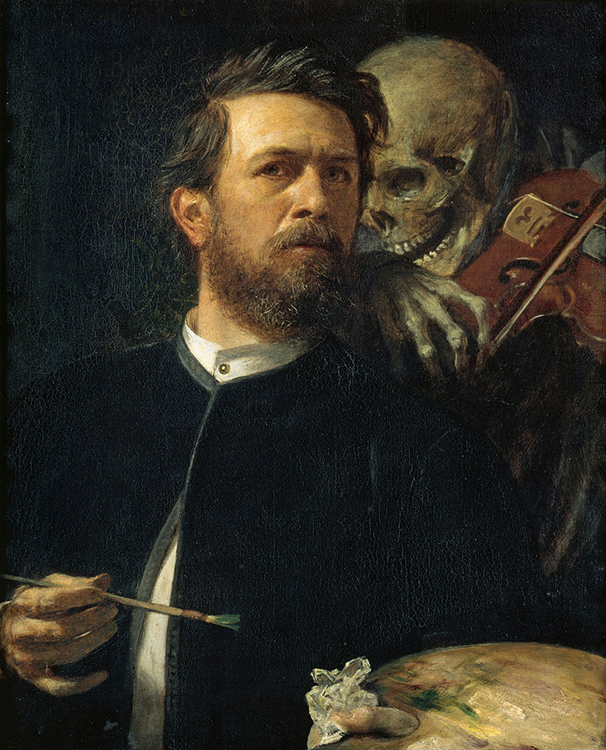
Abbado and the orchestra brought out the more demonic elements in the second movement’s Totentanz (Dance of Death). Leader Peter Danis, clearly relished and characterized his scordatura violin solos most vividly, evoking Freund Hein (Friend Henry) - a skeleton who plays the fiddle and is a traditional German personification of death by poet Matthias Claudius. According to Mahler's widow Alma, Mahler took inspiration for this movement from an 1872 painting by the Swiss artist Arnold Böcklin entitled Self-Portrait with Death playing the Fiddle. Calmer interludes offered some contrast in the manner of a Ländler, Abbado and the MPO wonderfully capturing the spirit of the dance.
The third movement is marked “serene” and Abbado unfolded it in a hymn-like manner with ravishing string tone that almost verged on inaudibility. The set of variations that slowly unfolded was full of calm nobility and tender soulfulness, sculpted into longer arches of sound into a higher state of bliss. When the music changed into a grandiloquent E major signaling the opening of heaven's gates, rising soprano Lauren Snouffer tip-toed into an empty seat in the midst of the first violins.
Moving centre stage swiftly as the fourth movement began, Snouffer would have benefited from sharper German diction and better projection over the orchestra. Nonetheless, her lovely tone served the text of Das himmlische Leben (The Heavenly Life) well, gorgeous and delicate. Abbado and the MPO thoughtfully complemented Mahler’s often very detailed word painting. At the end, Abbado left us relishing the radiant meadows of this ineffably beautiful view of heaven.
In the second half, Snouffer was the ardent soloist in Samuel Barber’s Knoxville: Summer of 1915 in a performance where both she and Abbado took a non-sentimental approach and a preferred moderate tempo. Her deeply moving rendition utterly enchanted the audience, though her diction was again not always ideally crystal clear.
A wondrous performance of Wagner's unequivocal masterpiece, the Tannhäuser Overture closed this magnificent concert. Abbado led the chorale invoking the Pilgrims’ Chorus in a grandly expansive and stately manner. The Allegro representing the sensual, impious Venusberg was attractively evoked: the feathery, frivolous skittishness of the strings, the uneasy, irregular swellings of sound threatening to go ballistic and the percussive battery of the grand central climax. The final reprise of the Pilgrim’s Chorus was once again sumptuous and solemn, with an altogether righteous Wagnerian majesty.
Sunday, 17 June 2018
Igudesman & Joo bring the house down
The utterly uproarious virtuoso violinist Aleksey Igudesman and pianist Hyung-Ki Joo were back in Kuala Lumpur with their delightfully new orchestral show "UPBEAT". A full house turned up to watch a virtuoso performance by both these highly feted artists who have played here before in shows like A Little Nightmare Music and BIG Nightmare Music as well as making an appearance with Gidon Kremer and the Kremerata Baltica since 2009.
Proceedings opened with "An Austrian in America", commissioned by the Pittsburgh Symphony Orchestra to honour its music director Manfred Honeck. Fighting with each other to give the opening upbeat, Igudesman and Joo took us through an uproarious musical journey of the five-movement pastiche of Mozart's Eine Kleine Nachtmusik, Johann Strauss Sr's Radetzky March and Johann Strauss Jr's Wiener Blut as well as popular American tunes like Yankee Doodle Dandy and Oh My Darling Clementine and Stephen Foster's Oh! Susanna.
Igudesman & Joo’s orchestral “Ring in the Classics” NOKIA ringtone symphonic poem commissioned by the New York Philharmonic Orchestra was yet another memorable item. The familiar NOKIA ring tone that we know so well usually causes serious musicians much anxiety and stress. But the MPO musicians began playing the tune themselves and proceeded to elaborate on that popular melody with snippets of Beethoven's Fifth Symphony, Dvorak's Ninth Symphony, Tchaikovsky's Fourth Symphony and Ravel's Bolero thrown in by Igudesman and Joo for good measure.
They even gave a centennial tribute to Leonard Bernstein, which featured a medley that comprised America, Maria and I Feel Pretty from West Side Story. A Wagner-based offering entitled Ride of the Oy Veykyries saw Joo getting married to Igudesman to strains of the Bridal Chorus from Lohengrin.
A new Grieg sequence that comprised the doleful Air from the Holberg Suite featured Joo on the piano extemporizing the beautiful slow tune. A more virtuoso offering from Joo utilized the jazzy Presto third movement from Ravel's G major Piano Concerto. Another Ravel offering was that of the virtuosic Tzigane, coruscatingly played by Igudesman on the violin.
Further laughs emanated from the audience when Igudesman initiated the sequence "Give Money for Greece". Audience singing was also encouraged in the "Mozart Will Survive" sequence, which also featured the tune from Pachelbel's Canon in D major.
Throughout the performance, the two were as committed to the same high quality of playing (and singing and dancing) as they were to their comedy. They never lost focus, and the audience was completely drawn in the whole way through as a result. I am sure that Malaysian audiences would love to see this zany duo back in Kuala Lumpur with another show like "And Now Mozart", "Play It Again", "Waltz of the World", "Music in Motion" or "League Of X-traordinary Musicians".
Thursday, 24 May 2018
Youthful musical spirits
German-Japanese conductor Jun Märkl made his debut with the Malaysian Philharmonic Orchestra in April 2018 with a series of vernal works by Debussy, Beethoven and Richard Strauss. For his opening work, the choice of Debussy's Children Corner Suite as orchestrated by André Caplet was an inspired idea. However, despite Caplet's expertise in orchestrating four key Debussy works, the semiquaver runs in the opening of Doctor Gradus ad Parnassum did not work well on the clarinet. It was often too sluggish in tempo and too detached in execution. The middle movements (Jimbo's Lullaby, Serenade for the Doll and The Snow is Dancing) were evocatively played. It was particularly memorable to note how Märkl encouraged the MPO principal oboist to play his haunting oboe solo in The Little Shepherd. Golliwogg's Cake-walk was a disappointment as it lacked swagger in Märkl's interpretation.
Malaysian pianist Melody Quah was the next debutant in this concert with Beethoven's Piano Concerto No 1 in C major Op 15. The opening tutti was arresting in its restraint, and Märkl’s taut control and nuanced detailing was apparent from the onset, imbuing the orchestral opening with a vigour befitting Beethoven's Allegro con brio marking. Quah's opening phrases were nicely articulated but her playing was often too choppy in her insistent use of staccato as well as a lack of judicious pedalling. She played with good accuracy, but sometimes more Beethovenian weight, attack and grandeur would not have gone amiss for most of this movement. Where Quah shone, was in her bravura playing of Beethoven's main spacious and elaborate cadenza at the end of the first movement.
Quah's tone in the second movement was too emphatic for the piano marking. This was at odds with the tranquil and introspective Largo of long, flowing and soulful hymn-like phrases. Despite this, there was notable contribution from clarinettist Gonzalo Esteban with his beautiful and limpid tone here. The Rondo finale is much the opposite of the tranquil second movement. Quah infused the extrovert piano writing with verve, swagger and jovial wit in the various appearances of the Rondo theme. A serene choir of winds provided a final moment of repose before the suitably energetic conclusion.
Strauss’ brilliant Don Juan opened the second half. The bold opening theme was played with a swagger with the MPO musicians surmounting the sizeable technical demands bar some usual trumpet and horn mishaps. In the quieter, more reflective moments, the principal oboist played his extended love song with a sumptuous lyricism. Throughout this work of extremes, Märkl painted a variegated tapestry of orchestral colour.
With its less opaque orchestration, Strauss’ Till Eulenspiegel's Merry Pranks which ended the concert fared very much better. Hornist Grzegorz Curyla's cheeky playing of the Till theme was memorable. Crisply articulated jocularity was also evident in the first clarinet solo. However, leader Peter Danis fluffed his key violin solo to the high E flat and the subsequent descending chromatic scale. The long tutti trilling fermata had oomph and precision and the gallows theme was suitably scary. Märkl’s effortless sense of Straussian syncopation and skilful tempo graduations was fluid and consistently impressive. This roguish interpretation was easily Märkl and the MPO's best performance of the night.
Monday, 14 May 2018
Skride & Danis star in Prokofiev's First Violin Sonata.
Baiba Skride offered the KL audience a captivating solo violin as well as a violin and piano recital after her dazzling performance of the Sibelius Violin Concerto with Gilbert Varga and the MPO from the night before.
Skride opened her recital with JS Bach's Solo Sonata No 1 in G minor BWV1001. In the opening improvisatory Adagio, Skride quickly entered a kind of personal cosmos, offering the entirely hushed audience a gorgeous reading of this sublime movement. In the following Fugue, she showed impassioned playing whilst exhibiting supreme confidence and technical accuracy in the nefarious multiple stopping of the complex fugal patterns. In the lilting Siciliano, Skride displayed remarkable subtle variations in her tone and expression. In the concluding Presto, the line scurried back and forth at warp speed with remarkable energy throughout the running semi-quaver figurations.
A thematic link to Skride's next offering was the fact that Eugène Ysaÿe wrote his Solo Sonata Op 27 No 1 in G minor after he heard the famous late Hungarian violin Joseph Szigeti playing Bach's BWV1001. Dedicated to Szigeti, Ysaÿe's work also abounds in technical difficulties. Skride despatched the opening Grave with its challenging multiple stopping magnificently, whilst imparting a musing and frail quality to the Fugato second movement. In the Allegretto poco scherzoso third movement, Skride made wide contrasts of the jazzy and pastoral elements of the music and concluded grandly in the Finale.
Prokofiev's Violin Sonata No 1 in F minor Op 80 was Skride's next offering. Joined by pianist Akiko Danis, Skride gave a magnificent account of this sonata which is increasingly popular on recordings and in the concert hall. Skride's carefully graded bowing suited the sombre and contemplative opening of the Andante Assai, whilst the muted ascending and descending violin scales created the effect of "wind in the graveyard" as the composer once described.
The second movement, the Allegro brusco, seemed to have been conceived of as a savage conflict between warring forces, represented by the piano and violin, both engaged in bitonal octaves and discordant rhythmic cross-fire. As a contrast to the barbaric second movement, Skride’s muted violin playing and Danis’ great delicacy in shading on the piano were most impressive in the gentle Andante third movement. The rhythmic shifts in metre of the final movement were expertly dealt with by Skride and Danis. The return of the first movement theme was played with icy beauty before a funereal knell brought the sonata to its enigmatic close.
Ravel’s virtuosic Tzigane closed the well-balanced programme. The opening solo violin passage was hypnotic in Skride's hands, with potency and warmth as well as a generous sprinkling of glitter and exhilarating changes of pace. However, some serious timing and ensemble problems between the violin and piano emerged in the Quasi cadenza section before resolution emerged ahead of the Moderato segment. Danis' piano support was sympathetic and pinpoint, with the duo bringing out all the colours with abounding technical brilliance and clearly having fun with the quirkiness and sheer gypsy virtuoso extravaganza.
Labels:
Akiko Danis,
Baiba Skride,
JS Bach,
Prokofiev,
Ravel,
Tzigane,
Ysaye
Tuesday, 10 April 2018
Skride's superb Sibelius Violin Concerto
Chen Shu-Si's Phoenix was a welcome musical hors d'oeuvre in Gilbert Varga's return concert with the MPO. I cannot believe that almost 10 years had elapsed since maestro Varga last appeared with the MPO in November 2008 with a colourful programme of Humperdinck, Glazunov and Ravel.
Chen's Phoenix was commissioned in 2012 by the Taiwan Philharmonic Orchestra but had never been heard in public. It was innovative programming by Varga that the MPO gave its world premiere six years after its completion. It was a pleasant surprise to hear such a tuneful composition, complete with a "Sheng" (an unusual ancient Chinese instrument) in the vibrant score, depicting a picturesque image of a happy phoenix gliding elegantly through the sky.
As with Varga's previous MPO concert which featured Glazunov's Violin Concerto and Ravel's Tzigane with James Ehnes, we had Baiba Skride making her DFP debut in Sibelius' Violin Concerto. The concerto opened with a slow Nordic chill, that was tempered by a very warm tone from Skride's ex-Yfrah Neaman Stradivarius and a lovely narrow vibrato. Skride gave the first movement a rhapsodic and introverted feel which worked well in concert. Varga was careful to rein the balance in the large orchestra assembled in the myriad solo passages but urged the orchestra forward with lyrical passion in the full-blooded teak-based tutti passages.
Her high notes floated in the stratosphere, supported by a beautifully and rich bowed tone and a judiciously applied vibrato. The fiendish cadenza put her exemplary technique through a gruelling test, which she passed with flying colours. For most of the first movement, her interpretation was a touch detached and dispassionate. As the final Allegro molto vivace kicked in, Skride went into overdrive in the flashing cross-string arpeggios and the myriad octaves and ended the movement with a wild, gypsy abandon.
The second movement was much like the first movement, with quite a broad tempo adopted. Here, the tone was warmer and vibrato rounder as Skride sustained the gorgeous melody with a bow arm of great lyrical intensity. The central climax was beautifully played and the pinnacle of the phrase (the high C) given its full due.
In the third movement (the “Polonaise for polar bears” in the celebrated phrase of British musicologist Sir Donald Francis Tovey), Skride was visibly at ease and enthusiastic whilst enjoying and surmounting its diverse technical challenges at a standard tempo.
After tumultuous applause, Skride gave the audience a stunning virtuoso solo encore, which was unannounced. Skride dispatched the encore piece which involved incessant string crossing and bariolage bowing, effortlessly.
Milhaud’s Le boeuf sur le toit, an exuberant, eccentric and light-hearted work strongly influenced by Brazilian music, followed after the interval. The title is that of an old Brazilian tango and the work fuses popular melodies, tangos, sambas and even a Portuguese fado interspersed with a recurring rondo-like theme. Varga and the MPO, made light of the work’s brash sonorities to create a performance which glittered with musical colour and light music-hall humour. Varga and the MPO, gave a mostly outstanding performance of this rarely performed work.
The concert ended with a spirited account of Kodály’s Dances of Galánta. The performance was full of exotic, folksy colours with virtuosic contributions from the woodwind principals, especially the clarinettist Gonzalo Esteban who coaxed the most sweet, smooth, subtle and sublime sounds from his instrument, performed with eloquent freedom.
Varga excelled in finding the wonderfully free rubato style and led the orchestra with a sure hand through the tricky and complex tempo changes. Varga had a great time, again wringing drops of colour from every section of the orchestra.
Friday, 30 March 2018
Cañizares steals the Spanish show
Juan Manuel Cañizares, the famous and legendary Spanish flamenco guitarist, ensured a full house at the DFP for the "From Spain With Love" concert conducted by David Giménez Carreras, who is the eminent tenor José Carreras' nephew.
The concert opened with a fair rendition of the 1916 orchestral suite from Manuel de Falla’s El amor brujo, a story of witchcraft and love which captures both the sensual and the demonic. The MPO under Giménez Carreras were on autopilot mode as the conductor failed to inspire the orchestra to evoke the intensity, passion and anguish of de Falla's colourful score. Tempi were often slower than usual and rhythms were very slack and not pointed at all.
Often, a lot of extra punch from Giménez Carreras was needed to inject much more vigour into proceedings. The fiery movements like the Dance of Terror and Ritual Fire Dance lacked zip and vim in the stomping rhythms especially. However, there were moments where de Falla is generous with solos and individual contributions from the woodwind (sinuous oboe playing from Elisa Metus) and strings (a particularly vibrant cello solo from Csaba Körös and a superb violin solo from Peter Daniš which was simple in its elegance) were a delight to hear.
The audience was especially thrilled when Cañizares emerged to play his compatriot Joaquín Rodrigo's evergreen Concierto de Aranjuez. A prodigious technician and supremely expressive player, Cañizares gave a masterful account of this much-loved work. The first movement was breezily paced and Cañizares' crisp technique ensured great clarity of textures. Despite the tempo of the fiercest scale passages, Cañizares was the epitome of relaxed virtuosity and every phrase was beautifully finished without any sense of haste.
The heart of the work is its extended slow movement with its two separate cadenzas. The MPO’s cor anglais player demonstrated a delicious range of colours during his solos, whilst Cañizares indulged in extended meditative arabesques. Cañizares steered a sensible course between tristesse, sentimentality and over-sophistication, revealing yet another impressive level of technical accomplishment. Yet this reading here was at times slightly overstated and much more impassioned (relative to his 2011 Madrid performance with the Berlin Philharmonic under Sir Simon Rattle on DVD), but received no corresponding passionate response from Giménez Carreras and the MPO.
The closing third movement was given a highly disciplined account from soloist and orchestra, with plenty of colour and variety whilst being infectiously buoyant. Applause for Cañizares was long and sustained and he returned for several curtain calls with his trademark disposition of quiet modesty. He rewarded the audience with an encore in the shape of his own virtuosic composition entitled El Abismo.
After the interval, Granados' lyrical Intermezzo from Goyescas served a short interlude before the closing two famous Spanish-themed pieces written by a Frenchman and a Russian. Giménez Carreras gave the audience yet another somnolent interpretation of Frenchman Bizet's popular Carmen Suite No 2, with little snap of the implied lively rhythms of the Habanera and the Chanson du toreador. The final Danse bohemienne was entirely pedestrianly paced and lacked swagger.
Russian composer Rimsky-Korsakov's Capriccio espagnol is one of my favourite orchestral pieces, which I know thoroughly from Lorin Maazel's barnstorming version from 1959 with the Berlin Philharmonic on earth-shattering form. The MPO and Giménez Carreras were again on poor form, with slack rhythms and a disinterest to bring out the festive Spanish tonal colours. The final Fandango was soporific and taken a sluggish pace, unlike the tour de force that it should be.
Thursday, 8 March 2018
Kochanovsky's triumphant Mahler 7
Having missed Stanislav Kochanovsky's previous appearances with the MPO in ballet performances of Prokofiev's Romeo & Juliet, Adam's Giselle and Tchaikovsky's The Nutcracker, I was determined not to miss his concert of two mainstream Romantic German works in the shape of Mahler's Seventh Symphony and Wagner's Prelude to Die Meistersinger von Nürnberg.
The Seventh is consistently dubbed a "problem" symphony because, for all its attractiveness, the musical arguments do not always seem to hang together. Kochanovsky's solution was to go for a sane and measured approach in the first movement, whilst playing the middle three movements characteristically and making the triumphant fifth movement an exhilarating wild roller-coaster ride.
After the opening "oars" motif of the first movement, Kochanovsky encouraged tenor hornist Marques Young to play his doleful solo forte (as written in the score). Often, this solo is presented too apologetically and not like what Mahler called "a roar of nature". There was a broad nobility to the all-important march theme in the winds that followed. Kochanovsky ensured that tempo relationships in this huge first movement were always logical, with minimum manipulation of tempi, as each section segued quite naturally into the next. Tension throughout the movement was properly cumulative, meaning that Mahler’s climactic suspension at the coda unfolded as it should, without the need for additional agogic emphasis.
The second movement of the Seventh Symphony is a nocturnal march. The MPO hornists played the call and response motif to open the movement before the main march theme (with a rhythm from his Das Knaben Wunderhorn song "Revelge") was taken up by the orchestra. Colourful elements such as cowbells in the distance and warbling woodwind bird calls instilled the movement with a pastoral feel throughout, evoking comparisons to Rembrandt's painting The Night Watch.
Kochanovsky made the third central movement downright strange and spooky. Creative touches in orchestration punctuated this movement which was replete with various waltz tunes and Ländler. Whether it was the slurping sounds of the violins playing the melody with glissandi up to their highest notes, the swirling viola parts, the Bartok-pizzicati in the cello and double bass parts or the shrieking of trumpets and woodwinds, Kochanovsky characterized every oddity at each turn. After all, Mahler marked the movement Schattenhaft (shadowy).
Kochanovsky’s baton-less response to the second Nachtmusik’s Amoroso marking was to apply a simple sensuality whose fervour stood in stark contrast to the macabre mood in the previous movement. Here, Peter Danis’ warm violin solo supported by Csaba Körös' sensuous cello line lent a tenderness and style to Mahler’s gentle interlude, with the orchestra’s "plucked" section (mandolin, guitar and two harps) adding a squeeze of zest to temper the sweetness.
In the Rondo-Finale, Kochanovsky and the MPO truly shone. Kochanovsky’s compact, crisp conducting style helped create a forward momentum to the end, important in a movement with seven iterations of the Rondo theme. The MPO brass came into their own here. In particular, the guest solo trumpet (Sergio Pacheco) sounded especially magnificent in Mahler’s stratospheric writing. It was a thrilling ride to the end of the movement, with the percussion section creating an irresistible rhythmic drive. The exuberant final chord was met with rapturous, well-deserved applause. This technically and interpretatively superb performance of the Mahler Seventh definitely trumped the dismal 2015 MPO outing with Fabio Luisi previously.
Kochanovsky chose to close the concert with Wagner's Prelude to Die Meistersinger von Nürnberg, obviously recreating the sequence of the programme of its Dutch premiere with the Royal Concertgebouw Orchestra of Amsterdam on 2 October 1909 under Mahler himself. The Prelude was played in a grand and stately manner with rich and luscious string tone, which had been lacking in some recent MPO performances.
On this showing, Kochanovsky's star is deservedly on the rise, with appearances with top world orchestras like the Royal Concertgebouw Orchestra of Amsterdam, Orchestre de Paris and Russian National Orchestra for 2017/18. Perhaps it could be time for the MPO to consider Kochanovsky for its vacant music director post.
Subscribe to:
Posts (Atom)