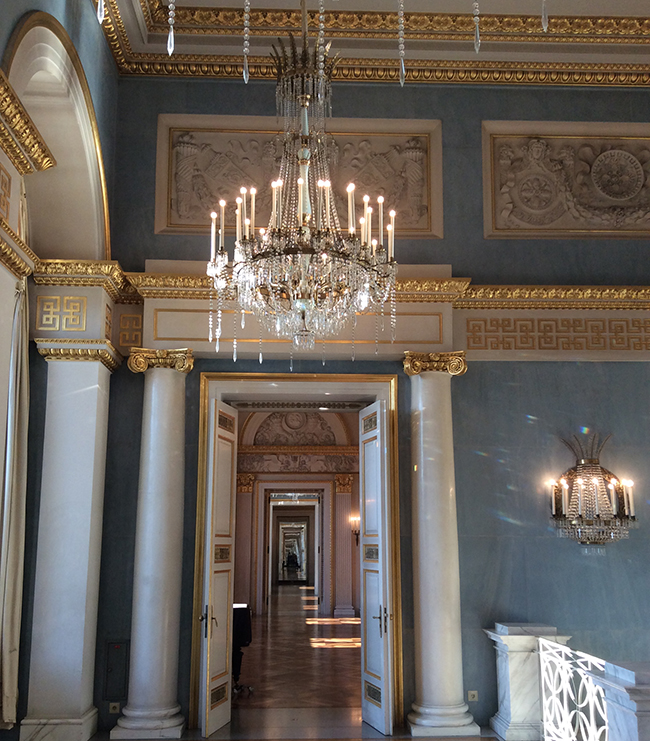
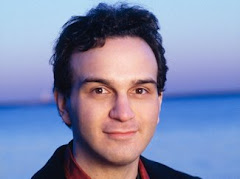
Publicity for the June 2017 concert was focused squarely on Nemanja Radulović. Walking on stage humbled by the capacity audience in the DFP hall, who were already rapturously applauding before having heard a single note of Tchaikovsky’s Violin Concerto, Radulović with a cloud of big fizzy hair looked greatly at odds with the surrounding orchestral musicians in concert tails and was surreally dressed in black leather trousers and jacket with knee-length Goth boots.
After an expectant and stylish tutti expertly led by Mark Wigglesworth, Radulović fined down his tone to a bare whisper, even below the requisite piano dynamic for the yearning opening section played in a quasi-improvisatory manner. Adding more warmth to his tone, he imbued the first subject with more vibrato and expression and it grew more agitated as double stops were added. Every melodic phrase was carefully shaped; if repeated, it was presented afresh with a vastly different tonal palette. The virtuoso high-speed scales and passagework had a crystalline but demonic quality whilst the more tender passages were breathtakingly intense and expressive.

Radulović infused the ben sostenuto il tempo section with a playfulness at a slower tempo. Again when the music expanded into sextuplets and demisemiquavers, Radulović instilled more boldness and attack into his playing and then refined his tone down for the warmly played second subject, which he imbued with a gorgeous singing tone and much romantic feeling. As the music picked up pace at the poco piu mosso section, we heard great variation between detache and spiccato in the exciting passage leading up to the next orchestral tutti, which burst forth in a full-blooded Polonaise rhythm.
Radulović played the following molto sostenuto il tempo, moderatissimo section with great delicacy and then after the second orchestral tutti, we heard a superb interpretation of the cadenza of much varied tone colour and character. As the recapitulation ushered in the flute solo, gorgeously played by Hristo Dobrinov, Radulović fined down his tone on his trills and looked at Dobrinov as if they were in a violin-flute love duet. The magnetic playing of the tender sections coupled with the virtuoso and coruscating close of the end of the first movement brought about much applause before the second movement could commence.

The second movement ("Canzonetta") achieved a chamber music-like intimacy particularly in the exchanges between the solo violin and orchestral flute and clarinet played lovingly by Hristo Dobrinov and Gonzalo Esteban respectively. Radulović's very hushed and intense playing in a sotto voce mode was still easily audible in the far reaches of the DFP hall, thanks to its lovely acoustic.

The finale was a vivacious and exhilarating Cossack dance featuring many exciting tempo changes. Despite the speeds of Radulović and Wigglesworth being exceptionally fast (After all, Tchaikovsky marked the basic tempo for the movement Allegro vivacissimo), the rhythms were extremely precise and alive. In the poco meno mosso section, Radulović's tone high up on the G-string resembled a rich cello sound, whilst in the more delicately scored sections; his artificial harmonics rang out clearly and sweetly. With mounting excitement in the coda with alternating multiple stopping and scampering semiquaver runs, Radulović, the MPO and Wigglesworth brought the concerto to a most thrilling close.
This magnetically Romantic and wonderful interpretation of the Tchaikovsky Violin Concerto brought tumultuous applause from the capacity audience. Rhythmic clapping (which is only reserved for the topmost echelon artists who visit KL) coaxed Radulović to play his favourite encore, the coruscating Paganini Caprice No 24 and Caprice No 5 in a pastiche arrangement by his compatriot, Aleksandar Sedlar.

The evening had begun earlier with Ravel's quaint Mother Goose Suite. Under Mark Wigglesworth's graceful gestures, the MPO brought out the variegated colours and elegance of Ravel's magical score. The opening “Pavane de la Belle au bois dormant” (“Pavane of the Sleeping Beauty”) was placid and unassuming with beautiful solos from the flutes led by Hristo Dobrinov. The solo oboe and cor anglais played by Simon Emes and Sven Buller respectively introduced the protagonist in “Petit Poucet” (“Tom Thumb”) dropping bread crumbs to find his way back, as noisy birds played by the woodwinds pecked them up.
Laideronnette, Empress of the Pagodas glittered, coloured by the exquisite harp playing by Tan Keng Hong, sensuous flutes and playful pentatonic scales by the MPO percussion section. In Les entretiens de la Belle et le Bête (Beauty and the Beast), the intertwining themes on clarinet and contrabassoon felt as if the Beauty and Beast were waltzing across the stage. The movement that felt truly magical was the closing one, Le jardin féerique (The enchanted garden) with its grand climactic conclusion.

In the second half of the concert, Wigglesworth and the MPO gave us a stunning interpretation of Stravinsky's Petrushka in its original 1911 version. It was a veritable performance of colour, rhythm, and mordant humour as Wigglesworth steered the orchestra through the work's polyrhythmic complexities with apparent ease and the MPO players responded with impressive precision.
The Shrovetide Fair tableau was exuberant, energetic and bursting with ebullience. The music related to the Moor was mysterious and menacing. Every section of the orchestra performed flawlessly, from the burnished sound of the violins, to the unusually crisp and in tune French horns, and the nicely articulated woodwinds. The concertmaster Peter Danis’ violin solos were affecting. The piano and celesta combination was also highlighted. The important contrabassoon punctuations were precise and rich, whilst the principal trumpeter was also very impressive in his many high-lying solos.

Mark Wigglesworth's performance was exceptionally vibrant, overtly dramatic and theatrical. The MPO had played Pétrushka many times in the last 20 years but they responded very well to Wigglesworth's interpretation. At the end, there was a great sustained ovation for both conductor and orchestra.
If my memory serves me right, this was the best Petrushka I've heard since 24 November 1981 in London with the Philharmonia Orchestra under Riccardo Muti. On the basis of this superb concert, Wigglesworth should be invited back to the MPO as its music director. Since the departure of Claus Peter Flor, the MPO had been meandering musically. I believe that Mark Wigglesworth could provide the MPO excellent musical direction, rebuild up their playing style and inspire them to greater music heights once again.

I remember years ago when Lorin Maazel conducted the MPO, it was talked about as the night the MPO played like the New York Philharmonic Orchestra (Maazel was the music director of the NYPO then) in Mussorgsky-Ravel's Pictures at an Exhibition. Well, in the case of this Radulović-Wigglesworth concert, the MPO played like the Bavarian State Orchestra (BSO) under the next Berlin Philharmonic Orchestra conductor designate, Kirill Petrenko. I watched my last Tchaikovsky Violin Concerto in Munich in 2016 and the soloist Frank Peter Zimmermann, the Bavarian State Orchestra and Kirill Petrenko were absolutely fantastic. (https://rabinfan.blogspot.my/2016/09/zimmermanns-coruscating-tchaikovsky.html)
One final wish is that Nemanja Radulović should be brought back soonest to the DFP for another concert of virtuoso fare like a Paganini Violin Concerto (maybe No 1, 2, 4 or 6), either of the Wieniawski Violin Concerti or Vieuxtemps' Fifth Concerto. He is such a magnetic personality on the violin, with a very wide range of dynamics and tonal palette, an excellently applied vibrato, pin-point intonation and a gorgeously rich tone. No wonder his autograph queue (longer than Ray Chen's and Sarah Chang's) spiralled the DFP Hall after the concert.
If I were a film maker and I were to re-make Peter Schamoni’s Spring Symphony film of 1983, I’d cast Nemanja Radulović in the role of Paganini playing his own Caprice No 17 at the beginning of the film. Nemanja Radulović is Paganini personified.